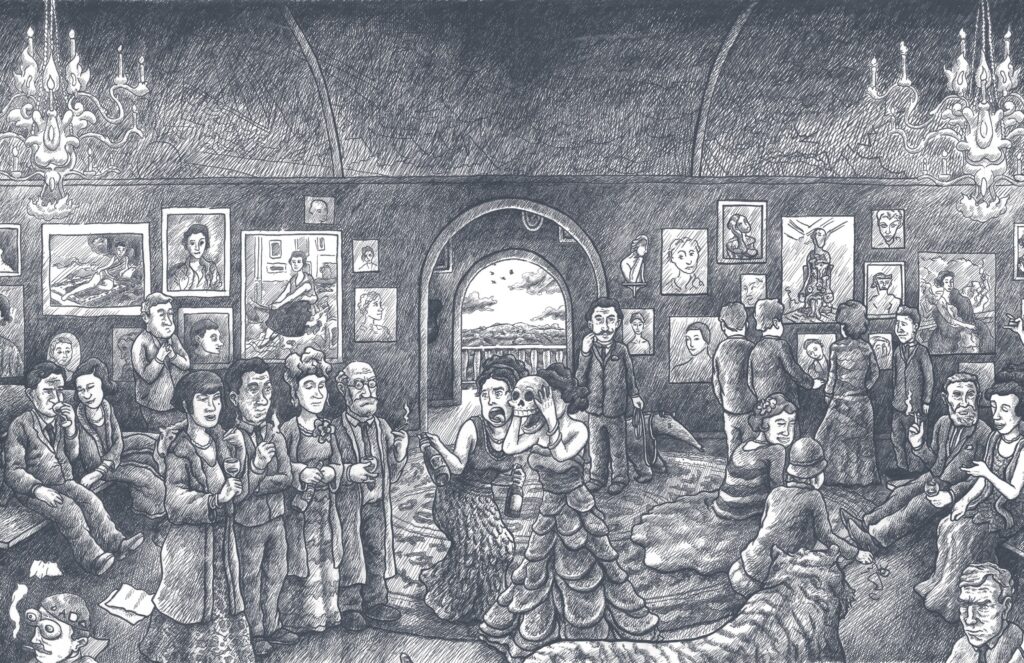
I never wanted to be an art historian. Art-making has always vexed me. From my earliest days doodling in kindergarten, the gulf between what I saw in my mind’s eye and what appeared on the page gave me vertigo. I obsessively tried to bridge it, but never could tame my treasonous hand. “An artwork is never finished, only abandoned,” Cocteau said (paraphrasing Valéry). I feel your pain, Jean, I feel it. I avoided art museums, which only underscored my shame.
My junior year of college, a physics major, my best friend (also a budding scientist) exhorted me to take “Dutch and Flemish Painting.” Perhaps because it had been four years since I’d been forced to endure an art class, his idea didn’t sound half bad.
A decade later, I was studying for my art-history PhD oral exams in a cramped armchair of a dusty attic library atop NYU’s Institute of Fine Arts, in its faux-French mansion on Manhattan’s Fifth Avenue, opposite Central Park, a few blocks down from the Metropolitan Museum of Art. I was spending an entire semester doing nothing but stuff my brain with facts that might prove useful on the upcoming day when three professors would spend an hour each grilling me on the entire artistic production of the West between 1789 and 1969.
This is a test that students fail with distressing regularity. One of my three executioners, errr, examiners, was particularly feared. I had seen him, on two occasions, bring graduate students (grown-ass twenty- and thirtysomethings!) to helpless tears during a comparatively inconsequential seminar presentation, over a picayune mistake.
So, I was determined to be as well prepared as possible. I implored every fellow student I could find for tips, strategies, and whatever bits of arcane art history they knew that could prove useful. Several of us formed a weekly study group to quiz each other on everything from the Barbizon group to Neo-dada.
But my primary task was to put my ass in a chair and absorb every text on the massive orals bibliography (counting over 300 books), down to the smallest footnotes. In one such, I read the curious story of an artist’s model who had been portrayed by some 55 artists in a single year, nearly every major artist of the time. I tried to think of a comparable moment in art history. At best, I could think of kings and queens who had portrayed by perhaps a dozen artists across several years.
My physicist brain lit up — what a laboratory! If the subject stays the same, all the better could we glimpse each artist’s individual temperament and weltanschauung. How had I never heard of her? Why was she a mere footnote? I memorized her name and vowed to one day return to her grand experiment.